顯示具有 Famille Rose 標籤的文章。 顯示所有文章

2017年2月14日 星期二

Message Behind the Bat Designs (Part I)


Ohhhh! Bears miss you guys so much!!!!  At the beginning of the Year of Rooster, we wish you all the best!   So, we will talk about something blessing - bat designs in Chinese art objects and what auspicious message behind the designs. This entry is written by my friend over the bear village, in exchange of few fishes, thanks for his kind effort!

Message Behind the Bat Designs (Part I)

In many Chinese art objects, such as ceramics, jade, gold paintings, textiles and etc., auspicious bat imagery can be found in the objects.  It is common to use symbols in art in many cultures, which makes the art objects unique.  It is worth noting that the Chinese language serves as the backbone of Chinese symbolism.  There are an abundant number of homophones in spoken Chinese, symbols derive meanings by pictorial puns or rebuses.

Bats are the most popular among of all pictorial puns, because the phonetic similarity with the character for “blessings” (, fu).  In Ming dynasty, bats had an unprecedented visibility in a wide range of materials.


The above Qing dynasty porcelain dish, from the Yongzheng period (1723-35), decorated with a total of eight peaches (five on the front and three on the back) growing flowering branches and five bats (three on the front and two on the back).  This composition of bat and peach became conventional during Yongzheng’s time.  

Bats as a pictorial pun for blessing while peaches are customarily associated with immortality.  It is said that Xiwangmu (西皇母), the Daorist goddess of longevity, grows peaches of immortality in her garden.  Peach trees need 3000 years to blossom and take another 3000 years to bear the fruit that will bestow immortality  on whomever consumes it.  In general, it is used to wish people with vast blessings, just like the blessings are filled in whole sky 

Look at the dish again, we can see the expansion of colours from the original overglaze enamels with its much greater variations in tone.  It captures the brush of fuzz and spots on the skin of mature peaches.  Besides, the branch extends from back over to the front of the dish is a design known as guozhi (過枝) or “crossing over the rim” that suggests the sound of changzhi (長治), meaning a long and peaceful reign, which is a compliment to the emperor and wish him has a long reign.  The red bats fly between two sides along the peach branch, forming a balanced and animated scene that charm the emperor for some time.  

*sniff* *sniff* 

We smell something fresh, sweet, juicy..... is it peach?  Sorry, it is time to enjoy delicious peach! Although it is not grown by Xiwangmu and we won't have immortal life after eating the peach, it is a healthy food for our life!

Next time, we will keep talking about bat designs.  Bye~~~~~

2016年7月5日 星期二

Qianlong porcelain bowl from Norton's Art

Hello guys, I know that I am mega lazy right now but since I receive some likes in my facebook, so I have decided to post some entries.  In this week, I have found an interesting piece that can showcase what we have learnt previously.

Preview Entry 9 - Norton's Art (Fine Chinese Ceramics, Painting, Works of Art) 7 July 2016


Chinese porcelain bowl, famille rose glazed, marked

Lot 8M
6 Characters (清乾隆年製) base mark
Estimated: $100 - $200

Motifs

For this piece, apart from the shape, we must be aware for the motifs on this piece.  As we can see here, we can find the butterfly (蝶), which has the meaning of longevity, double happiness (雙囍), and floral design that resemble peony (牡丹), which has the meaning of wealth.  For double happiness and butterfly, these motifs are well used in late Qing pieces especially during Tongzhi reign (同治 1856-1875).
Palace Museum, China
Now we explain why it is problematic

Motifs again
As we mentioned before, double happiness and butterfly motifs are common used in Tongzhi reign, to be honest here I haven't seen a Qianlong piece with this motifs combination (I seen butterfly motifs on Qianlong fabric though).  Actually it is very weird to see Tongzhi motifs (1856-1875) on a Qianlong piece (1711-1799).  I know time travel is possible but I don't think it is possible 200 years ago.

Another thing is the poor drawing of motifs, for the butterfly I think it is quite nice, similar to the pieces from Tongzhi reign.  But for the double happiness and Peony, they look questionable, I guess they spent all the budget on the butterfly.  The double happiness are separated, the peony is too simple.  I cannot find a Qianlong piece with Peony motifs yet, but as you can see here, you can see the really big difference.
Palace Museum, Taiwan
Weird mark
For the base mark, It was inscribed as “大清乾隆年製”.  Actually, it is okay to me if it is a piece from Tongzhi or Daoguang reign, since the mark is usually not very good in a famille rose piece, the production quality is dropping due to budget limitation.  The size for the mark is okay to me, not over sized or under sized.  Just one thing look weird to me, which is the "大", the head for the 大 is missing, I don't know if it is poorly photographed or what.


Shape
Actually I was going to skip this part since it is just too easy to spot the problem, the bowl is warped due to bad firing.  And the most important part is, it is not even a bowl, it looks like a satellite dish to me. seriously?

Conclusion
I think it worth the price if it is sold in $20, good for holding your key chain or coins, but I highly doubt that it is an authentic Qianlong piece.

So this is the preview after the long long vacation, I received lots of PMs from facebook, the pms and likes are meant a lot to me so I really thanks for the supports from you guys!


2016年1月6日 星期三

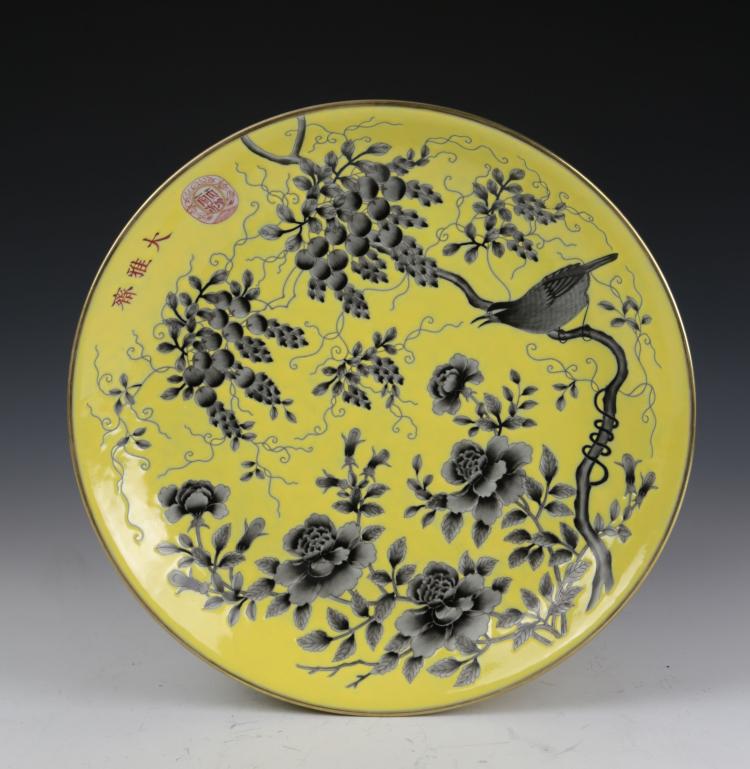
Qing Famille Rose Dayazhai Yellow Plate

Hello! Connoisseur bear here~ how’s your holiday?  I was having a good time, eat, sleep, eat, sleep, and eat some more…I am now so fat that I will have to get some new pants… oh no!

This week we are going to talk about a Qing famille rose yellow ground dish.  For this dish, our bears think it is interesting since it looked so good, but somehow there are still some small features that are problematic to us.  So, it is a good opportunity for us to discover and learn from this dish.

Preview Entry 8 - HGPY NY Auctions (Asian Fine art and Antiques) 16 January 2016


Qing Famille Rose Dayazhai Yellow Plate

Lot 63
4 Characters (慶長春) base mark
Estimated: $5,000 - $10,000

For the background information, supposing if this is a genuine piece, this piece is made for Empress Dowager, Cixi (1835-1908).  This group of pieces bear her special ‘Da Ya Zhai’ 大雅齋 (Studio of Great Elegance) marks, and were designed and produced during late Tongzhi period (1862-1874) or the early Guangxu period (1874-1908) (ref 1).  This type of wares are usually grisaille-decorated墨彩, and decorated with floral and bird motifs.

Here are the reasons why we think it is a questionable piece:

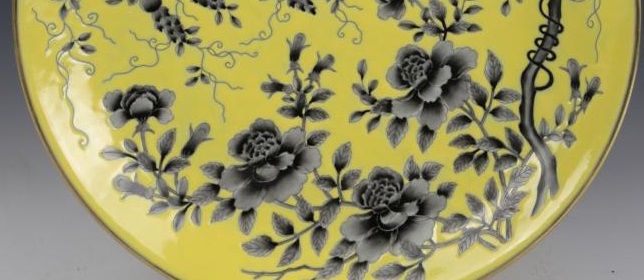
Density of the black
As we can see in this section, the motifs are grisaille-decorated, however, they are in a high density of dark color, for example the pedals and the bird.  For the pieces from Palace museum in China, as we can see the motifs are not in that density, and if you put them together we can see the difference.  One interesting side note for the grisaille decoration is, the darker area usually is the shadowed part of the motifs, it is to convey a sense of three dimension.  Feature like this started after Yongzheng period (1678-1735), at that time there were Western missionaries serving in the Qing Court, and they brought the knowledge of Western painting and the idea of linear perspective to Court painters.
Lot 63, Qing Famille Rose Dayazhai Yellow Plate
Yellow Ground Porcelain 'Flower and Butterfly' Plate, Dayazhai Mark, Qing Dynasty Guangxu period.
黃地墨彩花蝶紋盤
Collection of Palace Museum, China.


Glossy Surface/ Perfect Rim
For the glossy surface, we must be careful when we see a piece with glass-like reflection, for older piece it should be in a less reflective/ dull surface.  But please be aware even if you see a dull one.  If you see many scratch marks on a porcelain, it means it is treated with sand paper, people use sand paper to make the piece less reflective and to make it looks older.  For famille rose pieces, the sand paper method cannot be used, since it will remove the glaze.


For the perfect rim, it is also related to the condition of this piece, it is just too perfect, it is covered with brownish glazed completely.  Usually the coating should be damaged a bit.  It means A, it is in a really condition.  B, restored.  C, Modern.  

For reference piece, please see below bowl from British Museum, as you can see the rim is scratched a bit.  Also, the yellow ground is less reflective, perfect than the one from HGPY NY.
Porcelain Bowl, Collection of British Museum 

A side note for the brownish rim is, it seems to be a common feature for late qing imperial pieces to have a brownish rim, unlike previous periods like Qianlong and Yongzheng.

Beautiful, yet weird mark
For the base mark, It was inscribed as “Yongqing changchun” (永慶長春) (eternal prosperity and enduring spring), I must say it is nicely written, much better handwriting than I do.  However~, it is not similar with other Dayazhai pieces.  Please compare the style from this piece and the piece of Palace Museum (sorry for the quality).  

As we can see from the piece of Palace Museum (left), the circled strokes of 慶,長,春 are longer.  For the piece from HGPY NY auctions (right), they seems ‘taller’ and ‘slimmer’.  I must say the mark is the red flag for me.

Reference:
1. Ronald W. Longsdorf. 1966. "The Tongzhi Imperial Wedding Porcelain." Pp. 69-78.  In Orientations. Hong Kong: Orientations Magazine Ltd..

2.   故宮博物院編,《官樣御瓷──故宮博物院藏清代制瓷官樣與御窯瓷器,北京:紫禁城出版社(2007)。

3.   Bowl, British Museum,  (Ok I admit that lazy for this one)


So!  That’s the analysis for this week!  Time to eat some more~

Also!  Oh my god we got another Like for our Facebook page~~~~~~~~Thank you Chrissy Goh! You know every time when I see a like in our page, I dance in joy and jump around in my home.


2015年9月15日 星期二

Chinese Qing Porcelain Famille Rose Vase

Preview Entry 4 - Doyle (Asian Works of Art 09-14-2015)

A Pair of Chinese Famille Rose Glazed Porcelain Vases

Lot 359
6 Characters (大清光緒年製) mark
Estimated: $800 - $1,200
Realized Price: $7,000

OK, sorry guys for late update!  You know, as a scholar bear, we have to learn more and absorb more knowledge.  In last week, I started my Master Degree in Anthropology and worked really hard!  In this photo you can get a sense how serious I am during study (not joking).  Since this one is a late entry, perhaps I will try to summit two entries this week? Maybe?

For this week, I am really confused for the bidders, why would they bid for these two vases (8 bids currently)? Even Doyle stated they are from 20th century, which is modern.  But I think it is a great opportunity for me to teach you guys how to tell these vases are from private kiln/ modern production.
Brownish mouth rim coating

One of the element of private kiln production can be seen on the mouth rim.  Usually the mouth rim of these wares is covered in a thick brownish color coating.  The using of brownish color as the decorative element is a common practice for private kiln.

Poor written mark
I guess this is one of the worst mark I have ever seen in my life.  It was written as “Dai Qing Guangxu Nian Zhi” (大清光緒年製) (Made during the reign of Guangxu), but it is in a horrible condition and poorly written (state of the art I must say), which further confirm its private kiln origin.  As mentioned in previous entry, a poor mark usually accompany with a poor foot rim, these two vases are also in this case, we can see the foot rim of these two vases are pretty rough, which indicates the body of these two vases are poor.

Cursive calligraphy
For porcelains in later production, usually the written text is in semi-cursive script(行書) and cursive script(草書).  For the calligraphy style used for the imperial kiln during Qing dynasty, usually it is in regular script (楷書).  Also to note that, for some really bad imitation, we can even see text in simplified Chinese (簡體中文), which developed during People Republic of China period.

I must say it is very strange for people to bid for stuffs in condition like this, do they really know what they are bidding for?

2015年8月18日 星期二

Chinese Qing Porcelain Famille Rose Bowl

Preview Entry 1 - Wensly Auctions (Asian Works of Arts 08-29-2015)

Chinese Qing Porcelain Famille Rose Bowl

Lot 22
2 3/4 x 5 7/8"
6 Characters (大清雍正年製) mark

Estimated: $1,500-$3,000
Starting bid: $200


Hello there!  This is the first entry from our Connoisseur Bear.  In this blog, we will analyze different works of arts from different places, we hope that you can learn from those pieces, and be a good connoisseur, just like our bear!

So, in this week, we are analyzing a Qing Famille Rose Bowl with "Peach" theme.  Qing dynasty bowl with imperial mark is always a number one choice for collectors and dealers, and if it is decorated with Peaches(!), and with a imperial mark(!!), the combination can make the bowl worth over US$3,000,000 (Sotheby's, October 2011, HK0377, Lot16).  But wow, now you can buy it with $200, even our bear sniff around and say this bowl is kinda fishy (not salmon!).

Here's why:
1. High Contrast Peaches
By looking at the peaches, we can see the unnatural color because of the high contrast effect, the tips of those peaches almost turn into purple.  For the genuine one, the color is much natural. See the collection from Metropolitan Museum(MET) for reference:


2. Bat's wings
The next concern we have, is the wings for the bats, please notice the detail of the bat wings from the collection of MET, we can see the "fingers" of the bats, but for the one we featured this one, we cannot see any of them.  For a bowl with imperial six characters mark, it should be in superior quality, so it should not be painted in this way.

3. Bottom rim quality and the mark
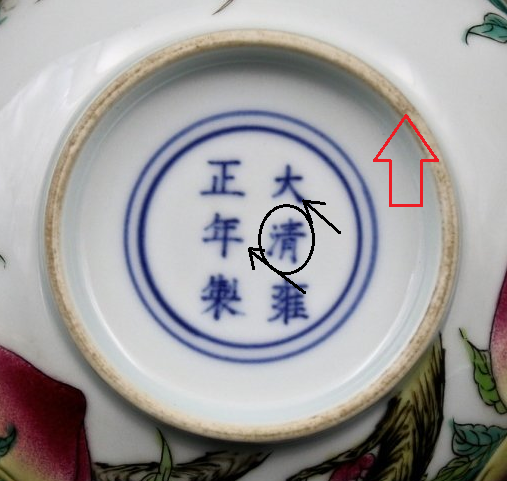
Basically, we stop inspecting if there is one thing in doubt.  But since we are here to teach, we will come across the bottom rim(red arrow) and the mark(black arrow) also,
First of all, we will look at the bottom rim first, the rim of this bowl is kinda "dirty", this is one of the red flags.  Bottom rim is where we can see the quality of a porcelain, we must know that the clay used by imperial kiln in Qing court must be in supreme quality, so the bottom rim supposed to be whitish and dense.  For rim like this, usually it happens in late Qing and Republic of China, since the quality of porcelain is affected by the budget of late Qing Court.  But you may see other areas of the bowl are whitish, it is because it is decorated with slip (化妝土), it is not the main body of the bowl.

After this, we will look into the mark, it is written as "Dai Qing Yong Zheng Nian Zhi" (大清雍正年製), which can be translated as "made in the reign of Yongzheng".  With this mark, it indicates this bowl supposed to be made from the imperial kiln during the Yongzheng period, and it is made for the internal use of Qing court.  I must be honest that the character "大,正,年,製" are nicely written, but for the character "清", it is kinda distorted toward the arrow's direction.  But the mark is kinda OK to me, since sometimes our bears can find stuff like this and laugh our ass off.


so these are the opinions and views from my boss, which is a bear.  If there are any questions, please let us know, and we will redirect it to the Connoisseur Bear.